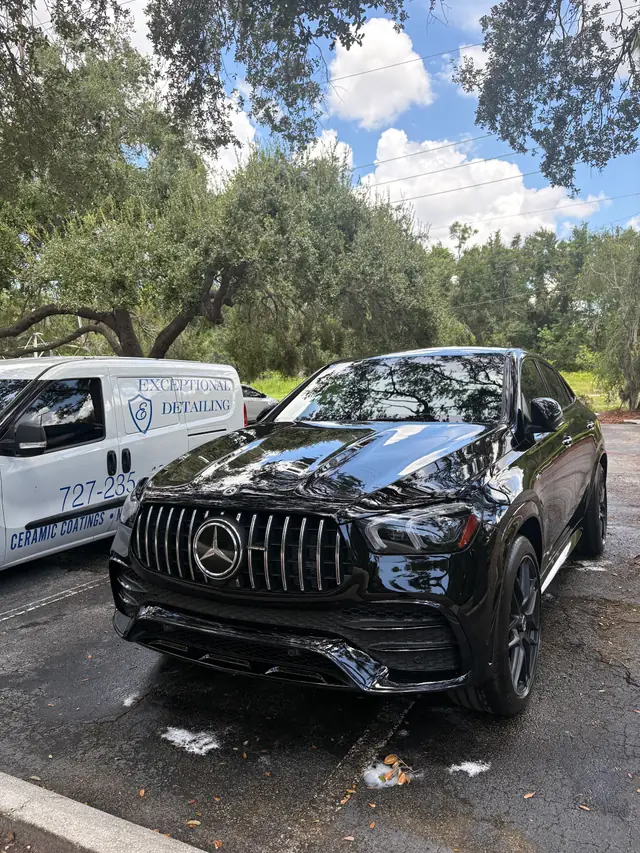
What does a ceramic coating lock in?
A ceramic coating bonds to the clear coat and stays there, which is the whole point and also the catch. Whatever is in the paint on coating day is what gets sealed under it: the swirl marks from automatic brush washes, the fine scratches from a dry towel, the haze left by seasons of sun. That is why paint correction comes first at Exceptional Detailing, and why the honest answer to "can you just coat it?" is usually "let's look at the paint under the lights first." The bay at 14605 49th Street North in Clearwater is lit by a honeycomb of white tubes for exactly that look.
A coating also doesn't make paint bulletproof. It adds a hard, slick layer that sheds water and makes dirt easier to wash off, and it helps the surface stand up to the light marring that regular washing causes. Rock chips and deep scratches are a different problem, and that is where film comes in. When you call (727) 235-4379, the first question is what the paint has been through, because a garaged coupe and a daily driver parked under oak trees need very different amounts of prep before anything gets sealed.
How the bay preps a car before the coating goes on
Prep is most of the job. The car gets a full hand wash first, then a decontamination pass to pull out what washing can't: iron fallout, tar, road film and the rough bonded grit you can feel with a hand on the paint after a wash. A clay bar follows, glided over lubricated panels until the surface feels like glass instead of sandpaper. Skipping this step is how coatings end up sealing contamination in, and it is the part nobody sees afterward. It happens in the bay or, for mobile work, with the trailer and the van parked in your driveway.
Next comes any paint correction the car needs, then a panel wipe: a solvent pass that strips polishing oils and leaves bare clear coat, so the coating bonds to paint and not to residue. The coating itself goes on panel by panel, in small sections, leveled and wiped off while the hex lights show every high spot and missed edge. Each panel is checked at an angle before the next one starts, since a high spot left to cure is hard to remove later. Prices are quoted per vehicle, after someone has looked at the car.
The trailer carries the words "Certified Ceramic Coating Installer" and the van is lettered Ceramic Coatings. One customer, kevin riley, wrote: "Chris and Aiden just completed 2 paint correction and ceramic coating jobs for me on separate specialty cars. The cars look phenomenal." He added: "They came to my house with all of the equipment needed to do a very professional job." Mobile or drop-off, the steps on a coating job are the same. Only the garage door changes.
Living with a coated car: the beading tell
Water beading is the tell. On a coated panel, rain and rinse water gather into tight beads and slide off, taking dust with them. When the beading goes flat and water starts to sheet and cling, the surface is telling you it wants a wash or a maintenance visit. Watch it over the first few washes so you know what normal looks like for your car. Hand wash with a clean mitt and car soap, working from the roof down, and dry with a clean microfiber towel instead of letting water dry in the sun.
Skip the brush tunnel. Spinning brushes carry grit from the car ahead of yours, and that grit is the main reason paint ends up swirled in the first place. Touchless washes avoid the brushes but lean on strong chemicals, which is not what you want on a fresh coating either. Between visits, rinse off bird droppings and bug splatter quickly, and never dry-wipe dust. In Clearwater, St. Pete or Tampa, call (727) 235-4379 about a maintenance wash, and if the car shows marks you want gone before a recoat, start with paint correction.